
Table of Contents
“AI isn’t just a tool that helps us work. It’s also a powerful weapon in the hands of bad actors.”
— Annie Quỳnh Anh, Marketing Director at VinCSS
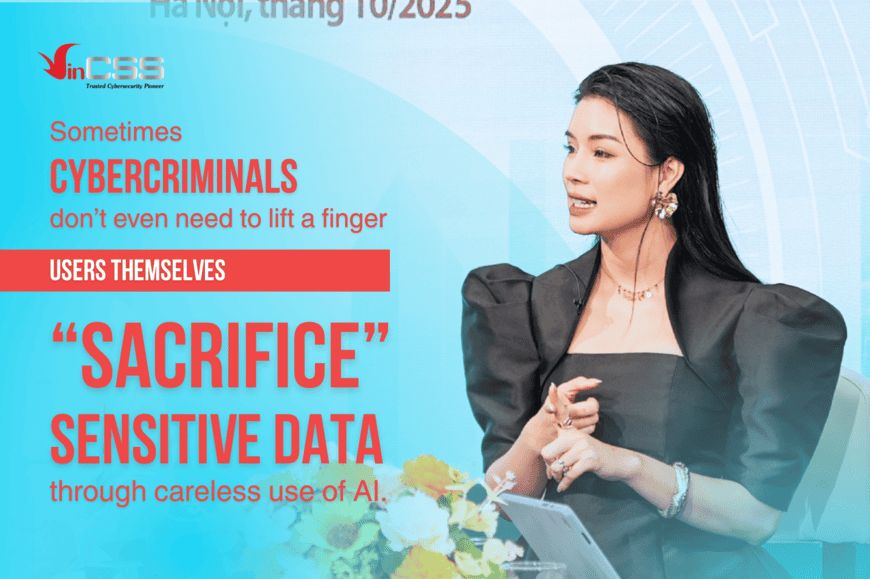
The explosion of artificial intelligence is ushering in a new era where the line between creative tool and weapon of attack is increasingly blurred. At the recent panel discussion “Cybersecurity and Social Development in Vietnam in the Age of AI and Digital Transformation,” held alongside the Ha Noi Convention, Annie Quỳnh Anh (Tech Lady), Marketing Director at VinCSS, painted a clearer picture of the growing cybersecurity risks in this AI-driven age.
Deepfake and the Two-Dollar Hacker: When Cybercrime Goes AI

In just the past two years, deepfake scams have surged by over 3,000% globally. At the same time, AI has turned cyberattacks into a mass-market service. “Phishing as a Service,” “Scam as a Service,” and “Ransomware as a Service” are AI-powered attack tools multiplying like “hacking zombies,” spawning a new generation of automated, sophisticated, and low-cost cybercriminals.
In a previous podcast produced by VinCSS, cybersecurity expert Hiếu PC shared that there are AI tools available for just two dollars a day—or even free—that allow anyone, even those without technical knowledge, to become a hacker.
AI: Fueling Faster, Cheaper, and Larger-Scale Attacks

A study from MIT revealed that 80% of current ransomware attacks are aided by AI. It can crack most passwords in under 60 seconds. AI doesn’t just make cyberattacks faster, cheaper, and more widespread, it also makes them harder to predict and defend against. AI-powered malware can learn and adapt to bypass security systems used by individuals and businesses.
When Your AI Assistant Turns Against You
The threat to information security also comes from the very AI tools we use every day.

Not long ago, Chevrolet’s AI assistant was “hypnotized” into selling a car for just one dollar. This incident clearly shows that AI tools designed to support individuals and businesses can be manipulated and turned against us.
When compromised, AI tools can leak user and organizational data or even provide harmful instructions. Moreover, without proper awareness and cybersecurity skills, users can easily expose their own sensitive information while using these tools.
The Battle Between Artificial Intelligence and Human Intelligence
During the panel, Annie Quỳnh Anh repeatedly emphasized the role of humans in the cybersecurity ecosystem of the AI era. As cybercriminals can “train” AI to attack, users and organizations must “train” themselves not to become the weakest link. They must also work closely with proven modern security technologies to build a safe and resilient foundation for long-term development.